2026 FAFSA Changes: Your Guide to Federal Student Aid

Anúncios
The 2026 FAFSA changes represent a significant overhaul of federal student aid, impacting eligibility, application processes, and aid calculations for US students seeking college funding, requiring proactive understanding and preparation.
Navigating the 2026 FAFSA Changes: What Every US Student Needs to Know for Federal Aid is crucial for anyone planning to pursue higher education. The Free Application for Federal Student Aid (FAFSA) is undergoing significant reforms that will redefine how millions of students access financial assistance. Understanding these modifications now will empower you to make informed decisions and secure the support you need for your academic journey.
Anúncios
Understanding the FAFSA Simplification Act’s Impact
The FAFSA Simplification Act, signed into law in 2020, aims to streamline the federal student aid application process and expand eligibility for Pell Grants. While some changes have already been implemented, the 2026 FAFSA will see the full rollout of these comprehensive reforms, fundamentally altering how financial need is assessed and how aid is distributed. This overhaul is designed to make the application less daunting and more equitable for a broader range of students.
These changes are not merely cosmetic; they represent a philosophical shift in how the Department of Education views and calculates a family’s ability to pay for college. Students and families who previously found the FAFSA complex or confusing should find the new process more accessible, though understanding the new terminology and calculation methods will be key to maximizing aid opportunities.
Anúncios
Key Changes to Expect
The upcoming FAFSA modifications introduce several significant alterations that applicants must be aware of. These changes will affect everything from the number of questions asked to how parental contributions are factored into aid eligibility. Preparing for these adjustments early can prevent potential delays or misunderstandings when it comes to applying for federal student aid.
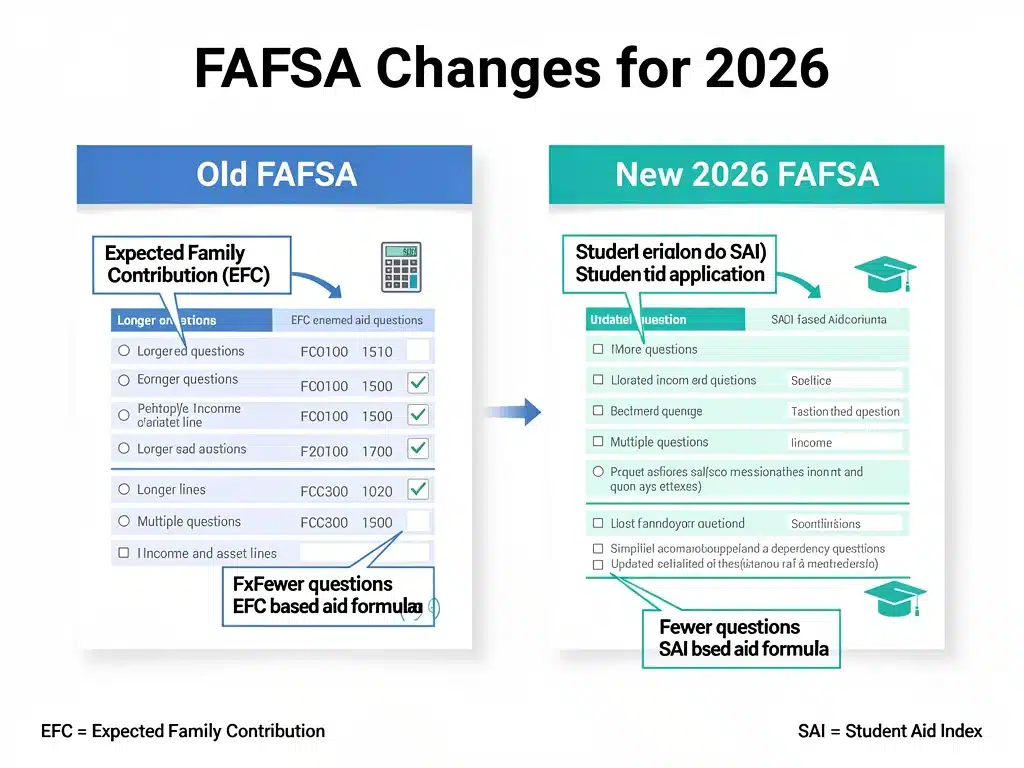
- The Expected Family Contribution (EFC) will be replaced by the Student Aid Index (SAI), a new metric designed to be more transparent and student-friendly.
- The number of questions on the FAFSA form will be significantly reduced, simplifying the application process for many families.
- New rules for divorced or separated parents will impact whose financial information is reported on the FAFSA, potentially changing aid eligibility.
Ultimately, the FAFSA Simplification Act seeks to create a more efficient and equitable system for students seeking federal financial aid. By understanding the core changes, applicants can better prepare themselves for the 2026 FAFSA cycle and beyond, ensuring they can access the resources necessary for their education.
The Shift from EFC to Student Aid Index (SAI)
One of the most impactful changes coming with the 2026 FAFSA is the replacement of the Expected Family Contribution (EFC) with the Student Aid Index (SAI). This new index is not a measure of what a family can or will pay, but rather an eligibility index used by financial aid administrators to determine federal student aid. The shift reflects an effort to make the aid calculation process more intuitive and less misleading for families.
The SAI calculation will differ from the EFC in several fundamental ways, potentially altering the amount of aid a student is eligible for. For instance, the SAI can be a negative number, indicating a higher level of financial need. This change aims to provide a more accurate reflection of a family’s financial situation and ensure that aid is directed to those who need it most.
How SAI is Calculated Differently
The new SAI calculation incorporates several modifications that were not present in the EFC formula. These changes are designed to offer a more holistic view of a family’s financial capacity, moving beyond just income to consider other factors that influence a student’s ability to afford college. Understanding these nuances is vital for students and families to estimate their potential aid eligibility accurately.
- Family size will now be directly linked to federal poverty levels, streamlining the process and potentially benefiting larger families.
- The number of family members in college will no longer be a factor in the SAI calculation, which could impact aid for families with multiple children pursuing higher education simultaneously.
- Child support received will be treated as an asset rather than income, potentially increasing aid eligibility for some recipients.
The transition to the SAI marks a significant departure from the traditional EFC model, promising a more transparent and equitable system for determining federal student aid eligibility. Families should familiarize themselves with the new calculation methodology to better anticipate their aid packages.
Simplified Application Process and Reduced Questions
A major goal of the FAFSA Simplification Act is to make the application process less burdensome for students and families. The 2026 FAFSA will feature a significantly reduced number of questions, transforming what was once a lengthy and often intimidating form into a more user-friendly experience. This simplification is expected to encourage more eligible students to apply for federal aid.
The reduction in questions is not just about convenience; it also aims to remove barriers that may have previously deterred students from completing the FAFSA. By focusing on essential information, the Department of Education hopes to make financial aid more accessible and less of a bureaucratic hurdle. This streamlined approach will benefit both first-time applicants and those who have applied in previous years.
What the Shorter FAFSA Means for You
The simplified FAFSA will require less time and effort to complete, but it also means that the questions asked will be more targeted and impactful. Applicants should still gather all necessary financial documentation before starting the application to ensure accuracy and efficiency. The goal is to make the process straightforward, but attention to detail remains paramount.
- Fewer questions mean less time spent on the application, reducing the potential for errors or omissions.
- The form will be more intuitive, guiding applicants through the necessary steps with clearer instructions.
- Data retrieval directly from the IRS will become mandatory for all applicants, further simplifying the income reporting process and enhancing accuracy.
The simplified FAFSA is a welcome change for many, promising a less stressful and more efficient path to securing federal student aid. Embracing this streamlined process will be key to a successful application for the 2026 academic year and beyond.
Changes Affecting Parental Contribution and Divorced Parents
The 2026 FAFSA brings significant changes to how parental financial information is considered, particularly for students whose parents are divorced or separated. These modifications aim to ensure a more equitable assessment of a family’s financial capacity, moving away from previous rules that sometimes created unintended disadvantages. Understanding these new guidelines is crucial for affected families.
Under the new rules, the parent who provided the most financial support to the student will now be the one required to report their information on the FAFSA, regardless of which parent the student lived with most recently. This is a notable departure from the previous rule, which often favored the parent with whom the student lived for the majority of the time. This change could significantly alter a student’s aid eligibility.
New Rules for Reporting Parental Income
The updated guidelines for reporting parental income and assets are designed to reflect a more accurate picture of a family’s financial resources available for college. This adjustment addresses concerns that the previous system sometimes did not fully capture the financial support a student received from both parents, especially in cases of divorce or separation. Proactive communication between parents will be more important than ever.
- The parent who provided the most financial support in the past 12 months must report their financial information.
- There will be clearer guidance on what constitutes ‘financial support’ to help parents determine who should complete the FAFSA.
- The new rules are intended to reduce confusion and provide a more consistent approach to assessing parental contributions.
These changes underscore the importance of understanding the specific requirements for parental financial reporting, especially for students from divorced or separated families. Careful attention to these details will ensure an accurate and timely FAFSA submission.
Pell Grant Eligibility Expansion and Other Federal Aid Updates
One of the most exciting aspects of the FAFSA Simplification Act, fully implemented by 2026, is the expansion of Pell Grant eligibility. This reform is designed to make federal grants more accessible to a greater number of students, particularly those with significant financial need. The expansion aims to reduce the financial burden of higher education and encourage more students to pursue college degrees.
The new Pell Grant eligibility determination will be linked directly to the federal poverty level and family size, simplifying the process and making it more transparent. Students from lower-income backgrounds are expected to benefit significantly from these changes, potentially receiving higher Pell Grant awards or becoming eligible for the first time. This expansion represents a substantial investment in making college more affordable.
Additional Federal Aid Program Adjustments
Beyond Pell Grants, other federal student aid programs may also see adjustments as a result of the FAFSA Simplification Act. While the core structure of programs like Federal Work-Study and federal student loans may remain, the underlying eligibility criteria, which are tied to the SAI, will inevitably be affected. Students should stay informed about how these broader changes might impact their overall aid package.
- The new SAI will be used across all federal student aid programs to determine eligibility for various types of assistance.
- Students may find it easier to qualify for certain federal loans or work-study opportunities due to the more equitable SAI calculation.
- Counselors and financial aid offices will have updated resources to help students understand their eligibility for a wider range of federal programs.
The expansion of Pell Grant eligibility and the broader impact on other federal aid programs are pivotal developments. These changes are poised to open doors for many students who might otherwise have found college financially out of reach, reaffirming the government’s commitment to educational access.
Preparing for the 2026 FAFSA: A Proactive Approach
Given the extensive nature of the 2026 FAFSA changes, a proactive approach to preparation is essential for all prospective and current college students. Waiting until the last minute could lead to missed opportunities or delays in receiving crucial financial aid. Early preparation ensures that you are well-informed and ready to navigate the new application landscape effectively.
Start by gathering all necessary financial documents well in advance. This includes tax returns, W-2s, and records of any untaxed income. Even with a simplified form, having these documents readily available will make the application process much smoother. Additionally, understanding the new terminology, such as the Student Aid Index (SAI), will be beneficial.
Steps to Take Now
Taking specific steps today can significantly ease your FAFSA application process when the 2026 form becomes available. These preparatory actions will help you understand your financial position and anticipate how the new rules might apply to your unique circumstances. Engaging with these steps early can make a substantial difference in your aid outcome.
- Create an FSA ID if you don’t already have one, as this is required for all applicants and parents.
- Research and understand the new SAI calculation to get a preliminary idea of your potential eligibility.
- Communicate with your family, especially if your parents are divorced or separated, to clarify whose financial information will be reported.
- Stay updated by regularly checking official Department of Education websites and your prospective colleges’ financial aid pages for the latest information.
By taking these proactive steps, students and their families can confidently approach the 2026 FAFSA, maximizing their chances of securing the federal financial aid needed to achieve their educational aspirations. Preparation is the cornerstone of success in this evolving financial aid environment.

Resources and Support for FAFSA Applicants
Even with the simplification efforts, navigating the 2026 FAFSA changes can still raise questions. Fortunately, numerous resources and support systems are available to help students and families successfully complete their applications and understand their aid options. Leveraging these resources can provide clarity and ensure a smooth process.
The Department of Education’s Federal Student Aid website (StudentAid.gov) is the primary and most authoritative source of information. It offers detailed guides, FAQs, and tools to assist applicants. Beyond official government resources, many colleges and universities have dedicated financial aid offices staffed with experts ready to provide personalized guidance.
Where to Find Help and Guidance
Knowing where to turn for help is crucial when dealing with complex financial aid processes. Whether you need assistance with specific questions about the application, understanding your eligibility, or appealing an aid decision, a range of support options exists. Don’t hesitate to reach out for assistance; it can significantly impact your financial aid outcome.
- Federal Student Aid Information Center: Provides phone and email support for FAFSA-related questions.
- College Financial Aid Offices: Offer personalized counseling and guidance specific to their institution’s aid packages.
- High School Counselors: Often equipped to help students complete the FAFSA and understand basic financial aid concepts.
- Non-profit organizations: Many organizations offer free FAFSA workshops and one-on-one assistance to local communities.
Utilizing these resources can demystify the FAFSA process and ensure that you are well-supported as you apply for federal student aid. Proactive engagement with available help can make a significant difference in securing the funding you need for your education.
| Key Change | Brief Description |
|---|---|
| EFC to SAI | Expected Family Contribution (EFC) replaced by Student Aid Index (SAI), a new measure of eligibility. |
| Simplified Application | Significantly fewer questions on the FAFSA form, making it easier and quicker to complete. |
| Parental Contribution Rules | New rules for divorced/separated parents: parent providing most financial support reports income. |
| Pell Grant Expansion | Expanded eligibility for Pell Grants, linked to federal poverty levels, benefiting more students. |
Frequently Asked Questions About the 2026 FAFSA Changes
The most significant change is the replacement of the Expected Family Contribution (EFC) with the Student Aid Index (SAI). This new index is designed to be a more accurate and equitable measure of a student’s financial need, potentially leading to increased aid eligibility for many.
For students with divorced or separated parents, the FAFSA will now require financial information from the parent who provides the most financial support, regardless of residency. This differs from previous rules and could alter aid calculations.
Yes, the 2026 FAFSA is designed to be significantly simpler. The number of questions has been drastically reduced, and mandatory direct data exchange with the IRS will streamline income reporting, making the application process more user-friendly for most applicants.
The Act expands Pell Grant eligibility, linking it more directly to federal poverty levels and family size. This change aims to make Pell Grants accessible to a larger number of students, particularly those with high financial need, potentially increasing award amounts.
Students should create an FSA ID, familiarize themselves with the new SAI concept, gather all necessary financial documents (tax returns, W-2s), and stay informed through official Department of Education resources and their college’s financial aid office.
Conclusion
The 2026 FAFSA Changes represent a pivotal moment in federal student aid, promising a more streamlined, equitable, and accessible system for millions of US students. From the transition to the Student Aid Index (SAI) to a simplified application process and expanded Pell Grant eligibility, these reforms are designed to ease the financial burden of higher education. Proactive preparation, including understanding the new rules for parental contributions and leveraging available resources, will be key to successfully navigating these changes. By staying informed and taking decisive steps, students can maximize their opportunities for federal financial aid, ensuring their path to a brighter academic future remains clear and achievable.