Understanding Capital Gains Tax in 2026: Reduce Your Burden

Anúncios
Understanding capital gains tax in 2026 involves navigating complex regulations, but strategic planning can significantly reduce your tax burden, potentially saving up to 15% through various exemptions and deferral methods.
For investors and individuals holding appreciated assets, understanding capital gains tax in 2026 is not merely an academic exercise; it’s a critical component of sound financial planning. As tax laws evolve, staying informed about the latest regulations and proactive strategies can significantly impact your net returns. This guide will equip you with the knowledge and actionable insights to navigate the complexities of capital gains tax and potentially reduce your tax burden by a substantial margin.
Anúncios
Decoding Capital Gains Tax: What You Need to Know for 2026
Capital gains tax applies to the profit you make when you sell an asset that has increased in value. This could include stocks, real estate, businesses, or even collectibles. The specifics of how these gains are taxed depend largely on how long you held the asset, categorizing them into short-term or long-term gains. Understanding this fundamental distinction is the first step toward effective tax planning.
Anúncios
The year 2026 brings with it potential adjustments to tax brackets and regulations, making it imperative for investors to review their strategies. While the core principles remain, even minor legislative changes can have significant financial implications. Staying abreast of these developments is key to optimizing your investment outcomes.
Short-Term vs. Long-Term Capital Gains
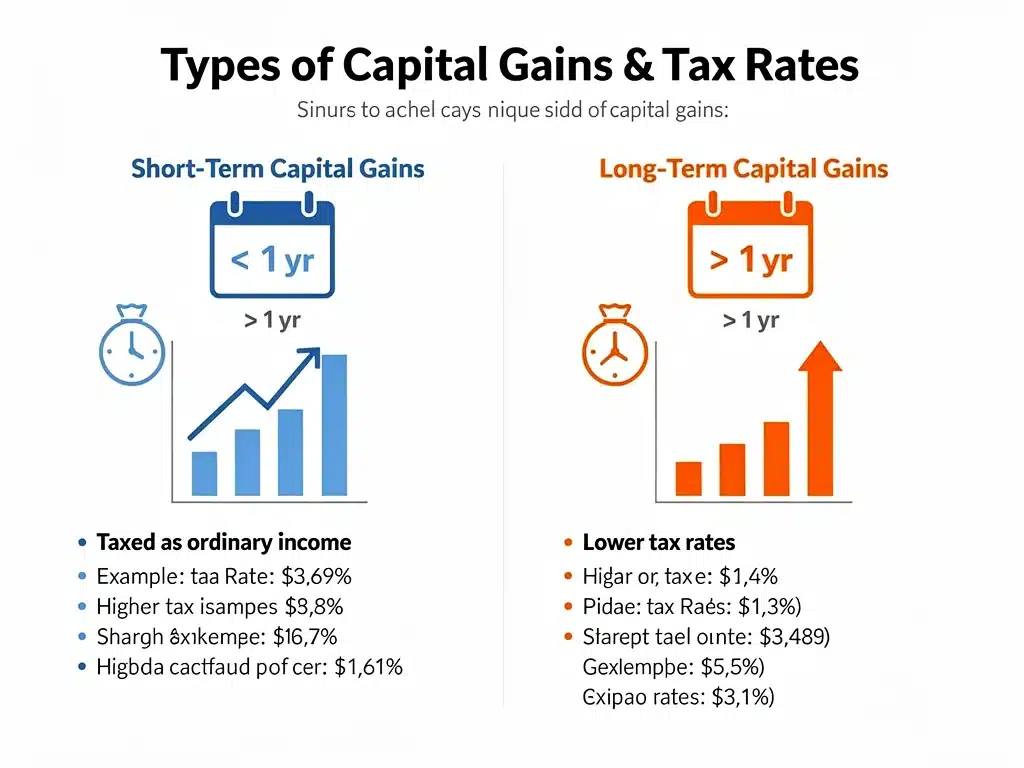
The distinction between short-term and long-term capital gains is paramount because they are taxed at different rates. Short-term capital gains are profits from assets held for one year or less, and they are typically taxed at your ordinary income tax rates. This means they could be subject to rates as high as 37%, depending on your income bracket.
- Short-term gains: Assets held for 365 days or less.
- Taxed as ordinary income: Rates can range from 10% to 37%.
- Higher tax burden: Generally less favorable than long-term gains.
Conversely, long-term capital gains, derived from assets held for more than one year, typically enjoy more favorable tax treatment. These rates are often lower than ordinary income tax rates, providing a significant incentive for long-term investing. The specific rates for long-term gains can vary based on your taxable income, generally falling into 0%, 15%, or 20% brackets.
The 2026 Tax Landscape for Capital Gains
While specific tax rates and income thresholds for 2026 are subject to final legislative decisions, it’s prudent to anticipate potential shifts. Historically, Congress has adjusted these figures for inflation and economic conditions. These adjustments can subtly alter the effective tax burden, making careful planning even more essential. Keeping an eye on IRS announcements and financial news will be crucial as 2026 approaches.
The goal is always to maximize your after-tax returns. By understanding the rules, you can make informed decisions about when to sell assets, how to utilize losses, and which investment vehicles best suit your tax strategy. This foundational knowledge empowers you to reduce your overall tax liability and keep more of your hard-earned investment profits.
Leveraging Tax-Advantaged Accounts to Minimize Your Burden
One of the most effective ways to reduce your capital gains tax burden is by utilizing tax-advantaged investment accounts. These accounts, designed to encourage savings for retirement or specific purposes, offer significant tax benefits that can shield your investments from immediate taxation. Understanding the nuances of each account type is crucial for maximizing their benefits.
These accounts provide a powerful shield against the annual erosion of investment gains through taxation. By strategically allocating your investments within these vehicles, you can significantly defer or even eliminate capital gains taxes, leading to greater wealth accumulation over time. It’s a cornerstone of smart financial planning.
Retirement Accounts: 401(k)s and IRAs
Traditional 401(k)s and IRAs allow your investments to grow tax-deferred. This means you don’t pay capital gains tax year over year on the growth within the account. Taxes are only paid when you withdraw funds in retirement, at which point they are taxed as ordinary income. This deferral can be incredibly beneficial, especially if you anticipate being in a lower tax bracket in retirement.
- Tax-deferred growth: No annual capital gains tax.
- Pre-tax contributions: Reduce current taxable income.
- Withdrawals taxed in retirement: Potentially lower tax bracket.
Roth 401(k)s and Roth IRAs offer an even more attractive benefit: tax-free withdrawals in retirement, provided certain conditions are met. While contributions are made with after-tax dollars, all qualified distributions, including capital gains, are entirely tax-free. This makes Roth accounts ideal for those who expect to be in a higher tax bracket in retirement or who simply prefer the certainty of tax-free income later in life.
Health Savings Accounts (HSAs)
Often overlooked as an investment vehicle, Health Savings Accounts (HSAs) offer a triple tax advantage: tax-deductible contributions, tax-free growth, and tax-free withdrawals for qualified medical expenses. If you have a high-deductible health plan, an HSA can be an excellent way to save for future healthcare costs while simultaneously investing and avoiding capital gains taxes on your growth.
The growth within an HSA is not subject to capital gains tax, making it a powerful tool for long-term wealth building, especially if you can afford to pay for current medical expenses out-of-pocket and allow your HSA funds to grow. This unique combination of benefits makes HSAs one of the most tax-efficient accounts available for eligible individuals.
Strategic Asset Sales: Timing and Loss Harvesting
Beyond tax-advantaged accounts, the timing of your asset sales and the strategic use of investment losses can significantly reduce your capital gains tax liability. This involves careful planning and a thorough understanding of current market conditions and your personal financial situation. Impulsive decisions can often lead to higher tax bills.
Effective tax planning in this area requires a proactive approach, not just reacting to market movements. By integrating tax considerations into your overall investment strategy, you can minimize the impact of capital gains taxes and enhance your portfolio’s long-term performance. This approach is about maximizing efficiency.
Long-Term Holding for Lower Rates
As previously mentioned, holding an asset for more than one year ensures that any profits are categorized as long-term capital gains, subject to lower tax rates (0%, 15%, or 20%) compared to short-term gains (ordinary income rates up to 37%). This simple strategy can yield substantial tax savings, especially for higher-income earners. Patience truly pays off in the world of investing.
Before selling an asset, always check its holding period. If you are just a few weeks or months shy of the one-year mark, it might be financially advantageous to wait. The difference in tax rates can be significant enough to warrant a delay, turning a substantial tax payment into a much smaller one, or even none at all, depending on your income bracket.
Tax-Loss Harvesting
Tax-loss harvesting is a powerful strategy where you sell investments at a loss to offset capital gains and, potentially, a limited amount of ordinary income. For 2026, the rules for tax-loss harvesting are expected to remain consistent: you can use capital losses to offset capital gains of any type (short-term or long-term).
- Offset capital gains: Use losses to reduce taxable gains.
- Offset ordinary income: Up to $3,000 per year.
- Carry forward losses: Unused losses can be carried forward indefinitely.
If your capital losses exceed your capital gains, you can use up to $3,000 of the remaining loss to offset your ordinary income. Any losses beyond that can be carried forward indefinitely to offset future capital gains or ordinary income. This strategy is particularly effective during market downturns, allowing you to turn a negative situation into a positive tax outcome.
Understanding Basis and Capital Improvements
When calculating capital gains, your ‘basis’ in an asset is a crucial factor. The basis is generally the purchase price of an asset, plus certain costs associated with its acquisition and any capital improvements made. A higher basis means a lower capital gain, and consequently, a lower tax liability. This concept is particularly relevant for real estate and other tangible assets.
Many investors overlook the importance of meticulously tracking their basis, potentially leading to overpaying taxes. Properly documenting all relevant costs can significantly impact your final tax bill. It’s not just about the sale price; it’s about the net profit after all allowable deductions are considered.
Adjusting Your Cost Basis
Your cost basis isn’t just the initial price you paid. For real estate, it includes closing costs, legal fees, and significant improvements like a new roof or a major renovation. These additions increase your basis, reducing the taxable gain when you sell the property. For stocks, it might include commissions paid when purchasing shares.
Maintaining detailed records of all these expenses is vital. When it comes time to sell, having a well-documented adjusted basis can save you thousands in capital gains taxes. This proactive record-keeping is an investment in itself, ensuring you don’t pay more than your fair share to the IRS.

Capital Improvements vs. Repairs
It’s important to distinguish between capital improvements and routine repairs. Capital improvements add value to the property, prolong its useful life, or adapt it to new uses. Examples include adding a new room, upgrading the electrical system, or installing energy-efficient windows. These costs can be added to your basis.
- Capital improvements: Add value, prolong life, or adapt for new use.
- Increase cost basis: Reduces taxable capital gain.
- Examples: Room additions, system upgrades, major renovations.
Repairs, on the other hand, merely maintain the property in its current condition and are typically expensed in the year they occur, not added to the basis. Examples include fixing a leaky faucet, painting a room, or replacing a broken window pane. Understanding this distinction is crucial for accurate tax reporting and minimizing your capital gains.
Qualified Opportunity Zones and 1031 Exchanges
For investors looking to defer or even reduce capital gains taxes on a larger scale, Qualified Opportunity Zones (QOZs) and 1031 Exchanges offer powerful mechanisms. These strategies are often employed by sophisticated investors and can provide substantial tax benefits, particularly for those with significant capital gains from the sale of assets.
These specialized tools are not for every investor, but for those who qualify, they represent some of the most potent tax deferral and reduction strategies available. They require careful consideration and often professional guidance to navigate their specific requirements and maximize their benefits effectively.
Investing in Qualified Opportunity Zones (QOZs)
Qualified Opportunity Zones were created to spur economic development and job creation in distressed communities. Investors can defer or even reduce capital gains taxes by reinvesting their gains into Qualified Opportunity Funds (QOFs), which then invest in businesses or properties located in QOZs. This program offers three main tax benefits:
- Deferral of gains: Capital gains from prior investments can be deferred until 2026 or until the QOF investment is sold, whichever comes first.
- Reduction of gains: If the QOF investment is held for at least 5 years, the deferred gain is reduced by 10%. If held for 7 years, it’s reduced by 15%.
- Tax-free growth: If the QOF investment is held for at least 10 years, any appreciation on the QOF investment itself becomes tax-free.
The QOZ program provides a unique opportunity for investors to align their financial goals with positive social impact, all while enjoying significant tax advantages. It’s a complex area, but the potential rewards can be substantial for those who do their homework or consult with tax professionals.
1031 Exchanges for Real Estate Investors
A 1031 Exchange, also known as a like-kind exchange, allows real estate investors to defer capital gains taxes when selling an investment property, provided they reinvest the proceeds into a similar (like-kind) property within specific timelines. This strategy is a cornerstone of wealth building for many real estate investors, enabling them to continually roll over their equity without triggering immediate tax liabilities.
The rules for 1031 Exchanges are strict, involving specific deadlines for identifying and acquiring replacement properties. Failure to adhere to these rules can result in the entire gain becoming taxable. Therefore, engaging a qualified intermediary and seeking expert advice is essential to successfully execute a 1031 Exchange.
Charitable Giving and Estate Planning for Tax Efficiency
Beyond direct investment strategies, charitable giving and thoughtful estate planning can also play a significant role in reducing your capital gains tax burden. These approaches not only provide financial benefits but also allow you to leave a lasting legacy or support causes you care about deeply. They represent a more holistic approach to tax optimization.
Integrating philanthropic goals with tax planning can create a powerful synergy, allowing you to achieve both your financial and charitable objectives. These strategies are particularly relevant for individuals with substantial appreciated assets and a desire to give back.
Donating Appreciated Securities
Instead of selling appreciated stocks or mutual funds and then donating the cash, consider donating the securities directly to a qualified charity. When you donate appreciated assets held for more than one year, you can typically deduct the fair market value of the donation (subject to AGI limitations) and avoid paying capital gains tax on the appreciation. The charity, being tax-exempt, can then sell the securities without incurring capital gains tax.
This strategy offers a double benefit: a charitable deduction for you and avoidance of capital gains tax on the donated assets. It’s a win-win for both the donor and the recipient organization, making your philanthropic efforts more impactful and tax-efficient.
Charitable Remainder Trusts (CRTs)
A Charitable Remainder Trust (CRT) allows you to donate appreciated assets to a trust, receive an income stream for a specified term (either your lifetime or a set number of years), and then have the remainder of the trust go to a charity. The key tax benefits include an immediate income tax deduction for the present value of the charitable remainder interest, and the avoidance of capital gains tax on the sale of the appreciated assets within the trust.
CRTs are complex financial instruments and typically require significant assets to be worthwhile. However, for those with substantial appreciated assets and a desire to support charity while also generating income, a CRT can be an incredibly powerful tool for tax-efficient giving and estate planning.
The Role of Professional Guidance in Tax Planning
Navigating the intricacies of capital gains tax, especially with potential changes in 2026, can be challenging. While this guide provides a comprehensive overview of strategies, the specific application of these tactics depends heavily on your unique financial situation, risk tolerance, and long-term goals. This is where professional guidance becomes invaluable.
A seasoned tax advisor or financial planner can provide personalized advice, ensuring you leverage every available opportunity to reduce your tax burden legally and effectively. Their expertise can help you avoid common pitfalls and uncover strategies you might not have considered on your own.
Consulting with Tax Professionals
A qualified tax professional, such as a Certified Public Accountant (CPA) or an Enrolled Agent (EA), can help you understand the latest tax laws, project your capital gains liability, and recommend tailored strategies. They can also assist with accurate tax preparation and ensure compliance with all IRS regulations. Their knowledge can be the difference between significant savings and missed opportunities.
- Personalized advice: Tailored strategies for your unique situation.
- Up-to-date knowledge: Expertise on the latest tax laws and changes.
- Compliance assurance: Help with accurate filing and avoiding penalties.
When choosing a tax professional, look for someone with experience in investment taxation and a solid understanding of current and anticipated tax legislation. A good professional will not only help you file your taxes but also become a strategic partner in your financial journey.
Integrating Tax Planning with Overall Financial Strategy
Effective capital gains tax planning should not be an isolated activity; it must be integrated into your broader financial strategy. This includes retirement planning, estate planning, and investment management. A holistic approach ensures that all components of your financial life work in harmony to achieve your objectives efficiently.
A financial advisor can help you create a comprehensive plan that balances your investment goals with your tax efficiency goals. They can assist with asset allocation decisions, rebalancing strategies, and ensuring your portfolio is structured to minimize taxes while maximizing growth. This integrated approach is the hallmark of sophisticated financial management.
| Key Strategy | Brief Description |
|---|---|
| Tax-Advantaged Accounts | Utilize 401(k)s, IRAs, and HSAs for tax-deferred or tax-free growth and withdrawals. |
| Tax-Loss Harvesting | Sell losing investments to offset capital gains and up to $3,000 of ordinary income. |
| Long-Term Holding | Hold assets over one year to qualify for lower long-term capital gains tax rates. |
| Basis Adjustment | Increase your cost basis with capital improvements to reduce taxable gain. |
Frequently Asked Questions About Capital Gains Tax in 2026
Short-term capital gains, from assets held for one year or less, are taxed at ordinary income rates, potentially up to 37%. Long-term gains, from assets held over a year, benefit from lower rates, typically 0%, 15%, or 20%, depending on your income bracket. This distinction is crucial for tax planning.
Tax-loss harvesting involves selling investments at a loss to offset any capital gains you’ve realized. If your losses exceed your gains, you can use up to $3,000 of the remaining loss to offset ordinary income. Any additional unused losses can be carried forward indefinitely to future tax years, reducing future tax burdens.
Yes, real estate capital gains can be reduced by increasing your cost basis with capital improvements. Additionally, a 1031 Exchange allows investors to defer capital gains tax by reinvesting proceeds from an investment property sale into another like-kind property. Understanding these rules is vital for real estate investors.
Investing capital gains into a Qualified Opportunity Fund (QOF) allows for the deferral of the original gain until 2026 or until the QOF investment is sold. If held for 5 or 7 years, the deferred gain can be reduced by 10% or 15%, respectively. Holding for 10 years makes any appreciation on the QOF investment tax-free.
While this guide provides general information, professional advice is highly recommended. A qualified tax advisor or financial planner can offer personalized strategies tailored to your specific financial situation, ensuring you maximize tax savings and remain compliant with evolving tax laws in 2026. Their expertise can prevent costly mistakes.
Conclusion: Proactive Planning for a Favorable Tax Future
As we look towards 2026, the landscape of capital gains tax continues to evolve, presenting both challenges and opportunities for investors. The key to successfully navigating this environment and significantly reducing your tax burden lies in proactive, informed planning. By understanding the distinctions between short-term and long-term gains, leveraging tax-advantaged accounts, strategically timing asset sales, and meticulously tracking your cost basis, you can make smarter decisions that benefit your bottom line.
Furthermore, exploring advanced strategies like Qualified Opportunity Zones and 1031 Exchanges, alongside considering charitable giving options, can unlock even greater tax efficiencies for those with more complex financial profiles. Ultimately, integrating these tax-saving tactics into a holistic financial strategy, ideally with the guidance of experienced professionals, will empower you to minimize your capital gains tax liability and achieve your long-term financial goals with greater confidence and success.