Student Loan Repayment Strategies 2026: Reduce Payments by 20%

Anúncios
To significantly reduce monthly student loan payments by 20% or more in 2026, borrowers in the United States should explore income-driven repayment plans, federal loan consolidation, and private refinancing options tailored to their financial situation.
Are you feeling the weight of student loan debt? In 2026, understanding effective student loan repayment strategies is more crucial than ever for Americans aiming to alleviate financial pressure and reduce their monthly payments. This guide will equip you with the knowledge and tools to potentially cut your monthly student loan burden by 20% or more, focusing on actionable steps and available resources.
Anúncios
Understanding Your Current Student Loan Landscape
Before diving into specific strategies, it’s essential to have a clear picture of your current student loan situation. This involves knowing who holds your loans, what types of loans you have, and your current interest rates. Many borrowers are unaware of the nuances of their debt, which can prevent them from accessing the best repayment options.
Identifying whether your loans are federal or private is the first critical step. Federal loans often come with more flexible repayment options and borrower protections, while private loans might offer lower interest rates for those with excellent credit. Understanding these distinctions will guide you toward the most suitable strategies for your financial goals.
Anúncios
Federal vs. Private Loans: Know the Difference
Federal student loans are issued by the U.S. Department of Education and include Direct Subsidized, Unsubsidized, PLUS, and Perkins loans. They typically offer:
- Income-Driven Repayment (IDR) plans
- Loan forgiveness programs
- Deferment and forbearance options
Private student loans, on the other hand, are offered by banks, credit unions, and other financial institutions. They usually have:
- Fewer flexible repayment options
- Interest rates based on creditworthiness
- Limited borrower protections
Knowing your loan types helps you prioritize which strategies apply to your specific debt. For instance, IDR plans are exclusive to federal loans, while private loan holders might benefit more from refinancing.
Once you’ve categorized your loans, gather all documentation related to your interest rates, loan servicers, and current repayment terms. This comprehensive understanding forms the bedrock of any effective repayment plan. Without this clarity, it’s like trying to navigate a maze blindfolded.
Exploring Income-Driven Repayment (IDR) Plans
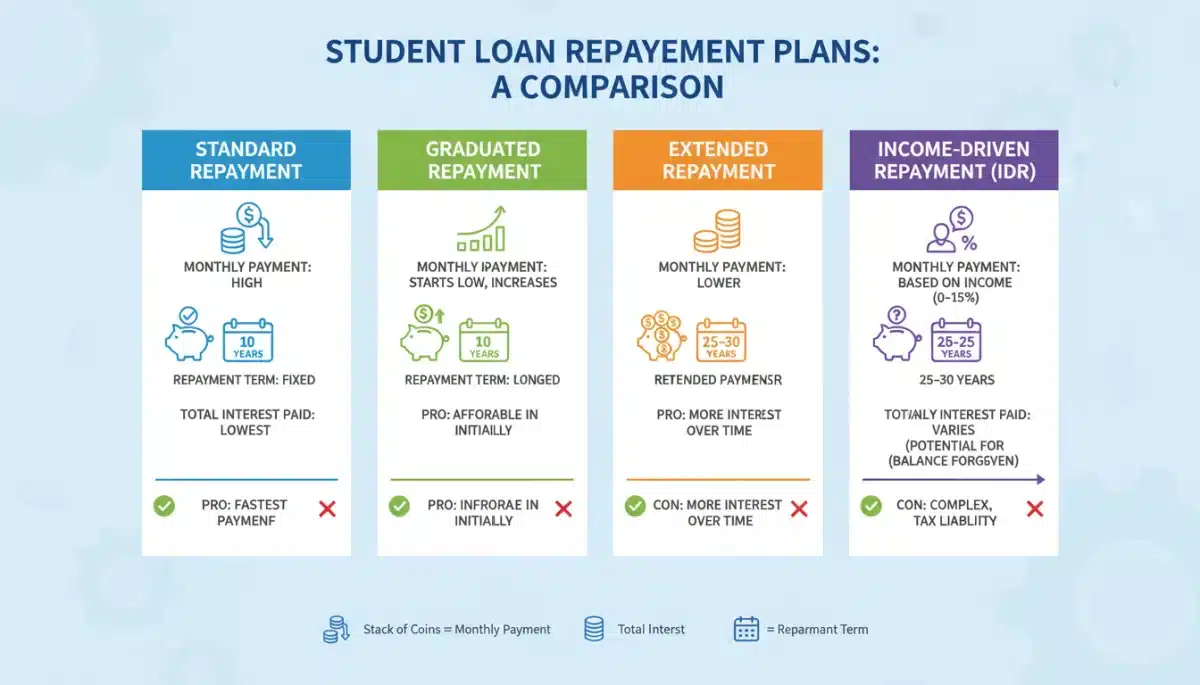
For federal student loan borrowers, Income-Driven Repayment (IDR) plans are often the most powerful tool for reducing monthly payments. These plans adjust your monthly payment based on your income and family size, making your student loan debt more manageable. In 2026, several IDR plans are available, each with slightly different terms and eligibility requirements.
The core idea behind IDR plans is to ensure that your student loan payments are affordable, typically capping them at a percentage of your discretionary income. After a certain period of payments, any remaining balance may be forgiven, though this typically comes with tax implications.
Key IDR Plans to Consider
The most common IDR plans include:
- SAVE Plan (Saving on a Valuable Education): This is the newest IDR plan, offering significant benefits, especially for low-income borrowers. Payments are calculated at 10% of discretionary income, and interest subsidies prevent your balance from growing if you make your required payments.
- Pay As You Earn (PAYE): Payments are generally 10% of your discretionary income, but never more than what you would pay under the Standard Repayment Plan.
- Income-Based Repayment (IBR): Payments are either 10% or 15% of your discretionary income, depending on when you took out your loans.
- Income-Contingent Repayment (ICR): Payments are the lesser of 20% of your discretionary income or what you’d pay on a fixed 12-year payment plan, adjusted for income.
To enroll or re-certify for an IDR plan, you’ll need to provide documentation of your income and family size annually. This ensures your payments remain accurate and affordable. Neglecting to re-certify can lead to your payments reverting to a higher standard amount.
Choosing the right IDR plan can be complex, as each has different eligibility criteria and benefits. A careful review of your financial situation and projected income is crucial to select the plan that offers the most significant reduction in your monthly payments while aligning with your long-term financial goals.
Federal Loan Consolidation and Refinancing
Federal loan consolidation and private refinancing are two distinct but often confused strategies for simplifying and potentially reducing your student loan payments. Understanding when to use each can significantly impact your financial outlook.
Federal loan consolidation combines multiple federal student loans into a single Direct Consolidation Loan. This can simplify repayment by leaving you with one monthly payment and potentially extending your repayment term, which can lower your monthly obligation. However, it typically results in a weighted average interest rate, meaning your rate might not decrease.
Benefits of Federal Consolidation
The primary advantages of federal loan consolidation include:
- Single monthly payment: Simplifies your finances and reduces the risk of missed payments.
- Access to more IDR plans: Some older federal loans might not qualify for certain IDR plans, but consolidating them can make them eligible.
- Extended repayment term: Can lower your monthly payment by spreading it over a longer period (up to 30 years).
Private loan refinancing, on the other hand, involves taking out a new loan from a private lender to pay off existing federal and/or private student loans. This is often pursued to secure a lower interest rate, which can significantly reduce both your monthly payments and the total amount of interest paid over the life of the loan.
Considerations for Private Refinancing
While private refinancing can offer substantial savings, especially for borrowers with good credit, it comes with important trade-offs:
- Loss of federal protections: Refinancing federal loans into a private loan means forfeiting access to IDR plans, federal deferment/forbearance options, and loan forgiveness programs.
- Creditworthiness required: Lenders typically require a strong credit score and stable income to qualify for the best rates.
- Potential for lower interest rates: This is the main draw, as even a small reduction in interest can lead to significant savings.
For those with a mix of federal and private loans, you might consider consolidating only your federal loans to retain their benefits, and then separately refinancing your private loans to secure a lower rate. This hybrid approach can offer the best of both worlds.
Strategic Budgeting and Extra Payments
Beyond restructuring your loans, adopting smart budgeting practices and making strategic extra payments can dramatically accelerate your repayment and reduce overall costs. This approach requires discipline but puts you firmly in control of your financial future.
Creating a detailed budget is the foundation. Track all your income and expenses to identify areas where you can cut back. Even small savings, when consistently applied to your student loans, can make a big difference over time. Remember, every dollar extra you pay goes directly towards reducing your principal balance, thus reducing the total interest you’ll pay.
Finding Funds for Extra Payments
Consider these avenues for generating extra funds:
- Side hustles: Freelancing, gig work, or part-time jobs can provide additional income specifically for loan payments.
- Cutting discretionary spending: Evaluate subscriptions, dining out, and entertainment expenses.
- Windfalls: Tax refunds, bonuses, or unexpected gifts can be directed towards your loans.
When making extra payments, always specify that the additional amount should be applied to the principal balance of the loan with the highest interest rate. This is known as the “debt avalanche” method and is generally the most cost-effective strategy. If you don’t specify, your servicer might apply it to future payments, which doesn’t save you as much on interest.
Even an extra $50 or $100 per month can shave years off your repayment term and save you thousands in interest. The key is consistency and making these extra payments a regular part of your financial routine. By actively managing your budget and directing surplus funds towards your loans, you empower yourself to achieve financial freedom sooner.
Leveraging Loan Forgiveness Programs
For certain federal student loan borrowers, loan forgiveness programs can offer a complete or partial discharge of their debt. These programs are typically tied to specific professions or circumstances and can provide immense relief. It’s crucial to understand the eligibility requirements and application processes for each.
Public Service Loan Forgiveness (PSLF) is one of the most well-known programs, designed for individuals working in qualifying public service jobs. After making 120 qualifying monthly payments under a qualifying repayment plan while working full-time for a qualifying employer, the remaining balance on Direct Loans may be forgiven.
Key Forgiveness Programs
- Teacher Loan Forgiveness: For teachers who work for five consecutive years in low-income schools or educational service agencies.
- Perkins Loan Cancellation: For borrowers in certain public service professions.
- Total and Permanent Disability (TPD) Discharge: For borrowers who are unable to engage in any substantial gainful activity due to a physical or mental impairment.
- Borrower Defense to Repayment: For borrowers whose schools engaged in misconduct.
The requirements for these programs can be stringent and often involve specific employment, loan types, and payment histories. Maintaining meticulous records of your employment and payments is vital if you intend to pursue any of these avenues. Certification forms often need to be submitted regularly to track your progress.
While loan forgiveness can seem like a distant dream, for eligible individuals, it represents a profound opportunity to eliminate student debt. Regularly checking your eligibility and staying informed about program updates can ensure you don’t miss out on these valuable benefits. Always be wary of scams promising quick forgiveness for a fee, as legitimate programs are free to apply for.
Avoiding Common Pitfalls and Seeking Professional Advice
Navigating student loan repayment can be fraught with potential missteps. Being aware of common pitfalls and knowing when to seek professional guidance can save you time, money, and significant stress. The student loan landscape is complex, and mistakes can be costly.
One common mistake is ignoring your loans. Burying your head in the sand can lead to default, which has severe consequences for your credit score and future financial opportunities. Proactive engagement with your loan servicer is always the best approach, even if you’re struggling to make payments.
Mistakes to Avoid
- Missing payments: Can lead to late fees, damaged credit, and eventually default.
- Not re-certifying IDR plans: Your payments will revert to a higher amount, potentially leading to financial strain.
- Falling for scams: Be skeptical of any company promising to fix your loans for an upfront fee.
- Refinancing federal loans without understanding the consequences: Losing federal protections can be a major setback if your financial situation changes.
When in doubt, seeking advice from a reputable non-profit credit counseling agency or a certified financial planner specializing in student loans can be invaluable. These professionals can help you analyze your specific situation, understand your options, and develop a personalized repayment plan. They can also help you avoid predatory services that promise unrealistic solutions.
Remember, your loan servicer is also a resource. They can provide information about your loan terms, repayment options, and how to apply for various programs. While they cannot offer financial advice, they are your primary point of contact for administrative questions and changes to your repayment plan. Staying informed and proactive is your best defense against student loan challenges.
| Strategy | Brief Description |
|---|---|
| Income-Driven Repayment (IDR) | Adjusts federal loan payments based on income and family size, potentially lowering monthly costs significantly. |
| Federal Loan Consolidation | Combines multiple federal loans into one, simplifying payments and extending terms. |
| Private Refinancing | Obtain a new private loan to pay off existing loans, aiming for a lower interest rate. |
| Strategic Budgeting | Implement a strict budget to free up funds for extra payments, accelerating debt payoff. |
Frequently Asked Questions About Student Loan Repayment
The SAVE Plan is a new Income-Driven Repayment (IDR) plan for federal student loans. It calculates payments based on a lower percentage of your discretionary income and prevents your loan balance from growing due to unpaid interest if you make your required payments, potentially significantly reducing your monthly outlay.
No, if you refinance federal student loans with a private lender, you will lose access to federal benefits like income-driven repayment plans, loan forgiveness programs, and generous deferment/forbearance options. It’s crucial to weigh these trade-offs carefully before proceeding with private refinancing.
You must re-certify your Income-Driven Repayment (IDR) plan annually, typically with updated income and family size information. Your loan servicer will notify you when it’s time to re-certify. Failing to do so can cause your monthly payments to revert to a higher, non-income-driven amount.
Yes, the Public Service Loan Forgiveness (PSLF) program remains available in 2026. It forgives the remaining balance on Direct Loans after 120 qualifying monthly payments are made under a qualifying repayment plan while working full-time for a qualifying public service employer. Eligibility rules apply.
While federal loan consolidation simplifies payments, it typically results in a weighted average interest rate, meaning your rate might not decrease, and could even slightly increase. Also, consolidating can restart the clock on any progress towards loan forgiveness programs, so assess carefully before consolidating.
Conclusion
Effectively managing student loan debt in 2026 requires a proactive and informed approach. By understanding your loan types, leveraging federal programs like Income-Driven Repayment plans, strategically considering consolidation and refinancing, and maintaining a disciplined budget with extra payments, you can significantly reduce your monthly burden. The goal of cutting your monthly student loan payments by 20% or more is entirely achievable with careful planning and consistent effort. Remember to stay informed about policy changes and seek professional advice when needed to ensure you are on the most beneficial path towards financial freedom.