Pell Grant Eligibility 2026-2027: New Requirements Explained

Anúncios
The 2026-2027 academic year introduces significant changes to Pell Grant eligibility, primarily driven by FAFSA Simplification, impacting how student aid is calculated and distributed to ensure more equitable access to federal grants.
Are you wondering how the upcoming changes will affect your college funding? Understanding the new Pell Grant eligibility requirements for the 2026-2027 academic year is crucial for students and families planning for higher education. These updates are designed to simplify the financial aid process and expand access, but they also introduce new calculations and considerations that everyone should be aware of.
Anúncios
The FAFSA Simplification Act: A New Era for Financial Aid
The FAFSA Simplification Act represents a landmark overhaul of the federal student aid system, aiming to streamline the application process and make college more affordable for millions of Americans. This legislative effort has been years in the making, with its full implementation phased in over several academic cycles. For the 2026-2027 academic year, students will experience the complete impact of these changes, particularly concerning Pell Grant eligibility.
One of the primary goals of this act is to create a more user-friendly experience for applicants. The old, often intimidating, FAFSA form has been a barrier for many potential students. By simplifying the questions and reducing the overall length of the application, the Department of Education hopes to encourage more individuals to apply for federal aid, ultimately increasing college enrollment and completion rates.
Anúncios
Key Changes Introduced by the Act
- Streamlined Application: The FAFSA form has been significantly shortened, reducing the number of questions from over 100 to approximately 36. This change aims to make the application less daunting and quicker to complete.
- Direct Data Exchange with IRS: A crucial enhancement is the direct data exchange with the IRS. This allows for most financial information to be automatically pulled from tax returns, minimizing errors and reducing the burden on applicants to manually input complex tax data.
- New Terminology: Several familiar terms are being replaced. The Expected Family Contribution (EFC) is now the Student Aid Index (SAI), and specific aid programs have new names or criteria.
The FAFSA Simplification Act is more than just a procedural update; it’s a philosophical shift in how federal student aid is conceptualized and delivered. It seeks to prioritize the needs of students from low-income backgrounds and simplify the path to higher education. Understanding these foundational changes is the first step in navigating the new Pell Grant landscape.
Understanding the Student Aid Index (SAI) and Its Impact
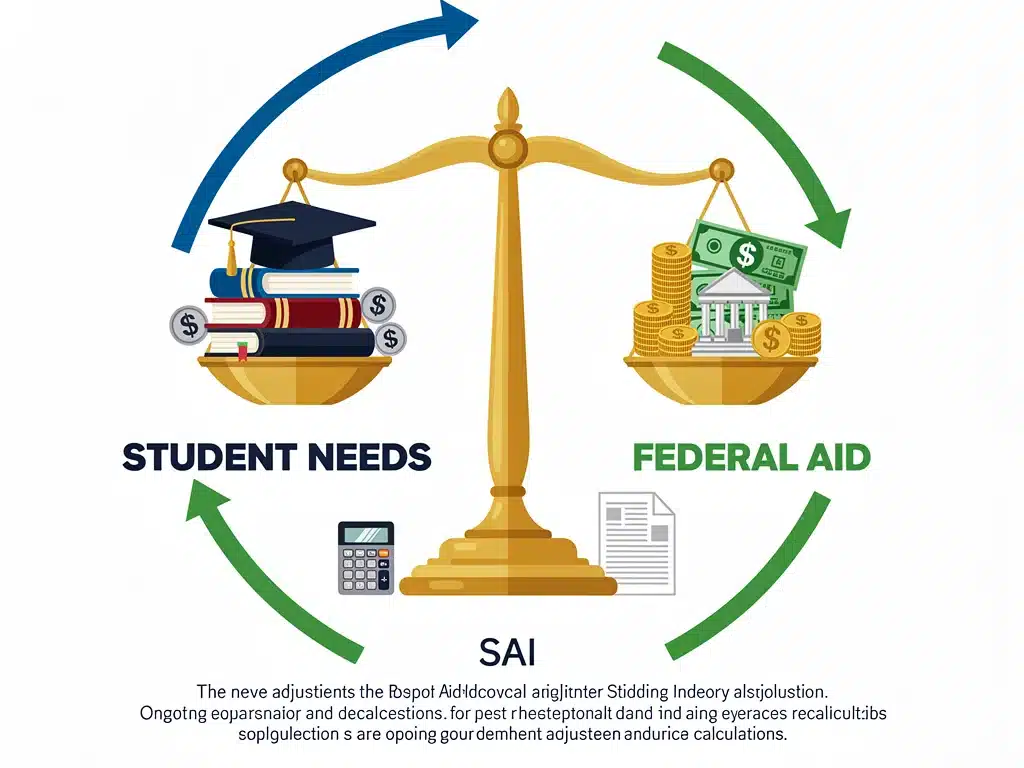
The most significant change affecting Pell Grant eligibility for the 2026-2027 academic year is the replacement of the Expected Family Contribution (EFC) with the Student Aid Index (SAI). While both are indices used to determine financial need, the SAI calculation is fundamentally different and is designed to be more equitable and transparent.
The EFC often left many students from middle-income families with little to no federal aid, even when they faced genuine financial challenges. The SAI aims to address this by focusing more acutely on a student’s and their family’s ability to pay, with a particular emphasis on protecting the lowest-income students. Unlike the EFC, the SAI can be a negative number, indicating a higher level of financial need than previously recognized.
How the SAI is Calculated
The SAI calculation considers several factors, but with altered weightings compared to the old EFC. Key elements include:
- Income: Adjusted gross income (AGI) remains a primary factor, but the new formula provides more generous allowances for income protection.
- Assets: Family assets are still considered, but specific changes have been made to how certain assets, like small businesses and family farms, are treated, potentially benefiting more families.
- Family Size: The number of family members supported by the household income is a critical component, with increased allowances for larger families.
The shift to SAI is expected to expand Pell Grant eligibility to more students, especially those from lower- and middle-income backgrounds who may have been excluded under the previous EFC model. This new index is a cornerstone of the FAFSA Simplification Act and directly influences the amount of Pell Grant aid a student can receive.
New Pell Grant Eligibility Criteria for 2026-2027
Beyond the introduction of the SAI, the 2026-2027 academic year brings specific new criteria that directly govern Pell Grant eligibility. These changes are designed to expand access and ensure that the grant reaches those who need it most, aligning with the broader goals of the FAFSA Simplification Act.
Historically, Pell Grant eligibility was largely determined by the EFC. Now, with the SAI, the calculation is more nuanced. The new framework introduces specific conditions that can guarantee a minimum or maximum Pell Grant award, regardless of the calculated SAI, for certain student populations. This is a significant departure from the previous system, which primarily relied on a single numerical threshold.
Key Eligibility Updates
For the 2026-2027 academic year, two primary pathways will determine Pell Grant eligibility:
- Maximum Pell Grant Eligibility: Students may be eligible for a maximum Pell Grant award if their adjusted gross income (AGI) falls below a certain threshold relative to the federal poverty level. This provision aims to simplify access for the lowest-income students, ensuring they receive the full benefit without complex calculations. Additionally, certain federal benefit recipients, like those receiving Social Security benefits, may also qualify for a maximum award.
- Minimum Pell Grant Eligibility: Even if a student’s SAI indicates they might not qualify for a full Pell Grant, they could still be eligible for a minimum award. This applies if their AGI is above the maximum Pell Grant threshold but still below a specified income level relative to the poverty line. This expansion ensures that more students receive some level of federal grant support, making higher education more attainable.
These new criteria mean that eligibility is no longer a simple pass/fail based solely on the SAI. Instead, a student’s family size, income, and participation in federal benefit programs can now play a more direct role in determining their Pell Grant award. It’s essential for applicants to understand these new pathways to accurately assess their potential eligibility.

How Marital Status and Family Size Affect Your Pell Grant
The FAFSA Simplification Act places a renewed emphasis on marital status and family size, recognizing their profound impact on a family’s financial capacity. For the 2026-2027 academic year, these factors will play a more central role in determining a student’s Student Aid Index (SAI) and, consequently, their Pell Grant eligibility.
Under the previous system, the treatment of divorced or separated parents, and the inclusion of siblings in college, often led to complex and sometimes disadvantageous outcomes for students. The new regulations aim to simplify these scenarios and provide more consistent and equitable results. The overarching goal is to better reflect a family’s true financial situation, rather than relying on outdated or overly rigid rules.
Changes in Reporting Parental Information
- Parental Income: For dependent students, the parent who provides the most financial support will be the one whose information is reported on the FAFSA, regardless of which parent the student lives with. This change is particularly relevant for students whose parents are divorced or separated, aiming to provide a more accurate picture of the household’s financial resources.
- Number of Children in College: The previous FAFSA reduced the EFC for families with multiple children in college. Under the new SAI methodology, this benefit has been removed. While this might seem like a disadvantage, the overall recalibration of the SAI, especially for lower-income families, is intended to offset this change and ensure that financial need is still adequately addressed.
The revised approach to family size and marital status is designed to be more intuitive and reflective of modern family structures. It underscores the Department of Education’s commitment to ensuring that the FAFSA accurately captures a family’s financial context, leading to more appropriate Pell Grant awards. Students and families should carefully review how these changes apply to their specific circumstances.
The Role of Cost of Attendance (COA) in Pell Grant Awards
While the Student Aid Index (SAI) determines a student’s financial need, the actual amount of Pell Grant awarded is also heavily influenced by the institution’s Cost of Attendance (COA). For the 2026-2027 academic year, the interplay between SAI and COA remains critical, but with a renewed focus on ensuring that Pell Grants effectively cover educational expenses.
The COA is not just tuition; it encompasses a comprehensive estimate of all expenses a student incurs while attending college. This includes tuition and fees, room and board, books and supplies, transportation, and personal expenses. Each institution calculates its own COA, which can vary significantly based on location, type of school (public vs. private), and whether the student lives on campus, off-campus, or with parents.
Calculating Your Pell Grant Award
The Pell Grant award is essentially the lesser of two amounts: the maximum Pell Grant for the year, or the student’s COA minus their SAI. This means that even if a student qualifies for a maximum Pell Grant based on their SAI, their actual award cannot exceed the total Cost of Attendance at their chosen institution.
- Example Scenario: If a student’s SAI is 0 (indicating maximum need) and the maximum Pell Grant for the year is $7,395 (the 2023-2024 maximum), but their school’s COA is $5,000, they would receive a Pell Grant of $5,000. If the COA was $10,000, they would receive the full $7,395.
- Enrollment Status: The Pell Grant award is also prorated based on enrollment status. Students attending full-time receive the full amount, while those attending half-time or less will receive a reduced award. This ensures that the grant aligns with the actual costs incurred for different levels of study.
Understanding your school’s COA is just as important as understanding your SAI. It provides a realistic picture of the total cost of your education and how much of that cost the Pell Grant can potentially cover. Financial aid offices at each institution are the best resource for detailed COA information.
Applying for Pell Grants: The FAFSA Process for 2026-2027
Applying for Pell Grants for the 2026-2027 academic year begins with completing the Free Application for Federal Student Aid (FAFSA). The FAFSA Simplification Act has significantly revamped this process, making it more accessible and less time-consuming for applicants. However, understanding the new workflow and key deadlines is crucial for securing federal financial aid.
The redesigned FAFSA form, often referred to as the ‘Better FAFSA,’ is central to these improvements. Its streamlined interface and reduced question count are aimed at removing barriers that previously deterred many students from applying. The move towards direct data exchange with the IRS is a game-changer, automating much of the financial information input and reducing the potential for errors.
Key Steps in the Application Process
- Create an FSA ID: Both the student and, if applicable, their parent(s) must have an FSA ID. This is a username and password used to log in to federal student aid websites and electronically sign federal student aid documents. If you already have one, ensure it’s active.
- Gather Required Documents: Although the FAFSA is more streamlined, it’s still wise to have certain documents on hand, such as Social Security numbers, driver’s license numbers, and records of untaxed income. While much of the tax information will be imported directly from the IRS, having a general understanding of your financial picture is beneficial.
- Complete the FAFSA Online: Access the FAFSA form on the official Federal Student Aid website. The new form will guide you through the process, with fewer questions and clearer instructions. Ensure all required contributors (students and parents, if dependent) provide their consent for federal tax information to be exchanged directly with the IRS.
- Review and Submit: Carefully review all information before submitting the FAFSA. Errors can delay the processing of your application. Once submitted, you will receive a FAFSA Submission Summary, which replaces the Student Aid Report (SAR) and provides your SAI.
Remember, the FAFSA typically opens in October for the upcoming academic year, but the specific opening date for the 2026-2027 cycle will be announced. Submitting your FAFSA as early as possible is always recommended, as some aid is awarded on a first-come, first-served basis. The simplified process should make this easier than ever before.
Maximizing Your Pell Grant and Other Financial Aid
While the new Pell Grant eligibility requirements for the 2026-2027 academic year aim to expand access, students and families should still proactively seek ways to maximize their financial aid opportunities. Understanding how Pell Grants interact with other forms of aid and knowing what additional steps you can take can significantly reduce the cost of higher education.
The Pell Grant is often considered the foundation of a financial aid package because it is grant money that does not need to be repaid. However, it’s rarely enough to cover the entire cost of attendance. Therefore, it’s essential to explore all available avenues, including other federal aid, state grants, institutional scholarships, and private funding options.
Strategies for Maximizing Aid
- Complete FAFSA Early and Accurately: As mentioned, submitting your FAFSA as soon as it opens is crucial. Early submission increases your chances for state and institutional aid that may have limited funds. Accuracy prevents delays and ensures you receive all the aid you qualify for.
- Apply for State Grants and Scholarships: Many states offer their own grant programs based on financial need, often linked to FAFSA submission. Research your state’s higher education agency for specific opportunities. Additionally, actively search for scholarships from various organizations, which can be merit-based, need-based, or tied to specific demographics or fields of study.
- Explore Institutional Aid: Colleges and universities often have their own scholarship and grant programs. Check with the financial aid office of each school you apply to, as they may require additional applications or essays beyond the FAFSA.
- Consider Work-Study Programs: Federal Work-Study allows students to earn money to help pay for educational expenses through part-time employment, often on campus. This is a form of self-help aid that doesn’t need to be repaid and provides valuable work experience.
Maximizing your Pell Grant and other financial aid requires a comprehensive approach. Don’t rely solely on one source of funding. By diligently completing applications, meeting deadlines, and exploring all available options, you can significantly reduce your out-of-pocket college costs for the 2026-2027 academic year and beyond.
| Key Point | Brief Description |
|---|---|
| FAFSA Simplification | Streamlined application, direct IRS data exchange, and new terminology for 2026-2027. |
| Student Aid Index (SAI) | Replaces EFC, can be negative, and aims for more equitable financial need assessment. |
| New Eligibility Criteria | Maximum and minimum Pell Grant eligibility based on AGI relative to poverty level. |
| COA’s Role | Cost of Attendance still limits the actual Pell Grant award amount. |
Frequently Asked Questions about Pell Grant Eligibility
The most significant change is the replacement of the Expected Family Contribution (EFC) with the Student Aid Index (SAI). This new calculation method aims to provide a more accurate and equitable assessment of a student’s financial need, potentially expanding eligibility to more students from lower- and middle-income backgrounds.
The FAFSA form will be significantly shorter, reducing the number of questions. It will also feature direct data exchange with the IRS, allowing for automatic retrieval of tax information. These changes are designed to simplify the application process and reduce errors, making it easier for students to apply for aid.
Yes, unlike the previous EFC, the Student Aid Index (SAI) can be a negative number, ranging from -1500 to 999999. A negative SAI indicates a greater financial need, which can qualify students for a larger Pell Grant award or other forms of need-based aid.
No, the benefit for having multiple family members in college that previously reduced the EFC has been removed under the new SAI methodology. While this specific reduction is gone, the overall FAFSA Simplification aims to provide more generous allowances for lower-income families.
The FAFSA typically opens in October for the upcoming academic year. While the exact date for 2026-2027 will be announced, it is highly recommended to complete and submit your FAFSA as early as possible after it opens, as some financial aid is awarded on a first-come, first-served basis.
Conclusion
The 2026-2027 academic year marks a pivotal moment for federal student aid, driven by the comprehensive FAFSA Simplification Act. The new Pell Grant eligibility requirements, centered around the Student Aid Index (SAI), aim to create a more equitable, transparent, and accessible path to higher education for millions of students across the United States. By understanding these significant changes—from the streamlined FAFSA application and direct IRS data exchange to the nuanced calculations of SAI and the specific criteria for maximum and minimum Pell Grant awards—students and families can better navigate the financial aid landscape. Proactive engagement with the application process, coupled with a thorough exploration of all available aid options, will be essential to maximize financial support and make college more affordable than ever before. NewQuik is committed to keeping you informed on these vital educational opportunities.